


Hypermetal took part in the 2nd Luso-French Defence Industry Day, held on 21 and 22 January 2026 at the Embassy of France in Lisbon. According to the official event page, the initiative was organised by idD Portugal Defence together with Portuguese and French institutional and industrial partners, and included presentations, B2B and B2G meetings focused on bilateral cooperation and industrial supply chains.
Represented by Afonso Nogueira, Hypermetal joined the event in a context centred on defence industrial priorities and cooperation opportunities between Portugal and France. For the company, this was a relevant setting to highlight how EN9100-certified metal additive manufacturing can support defence programmes, particularly in high-performance components, unmanned systems and propulsion applications.
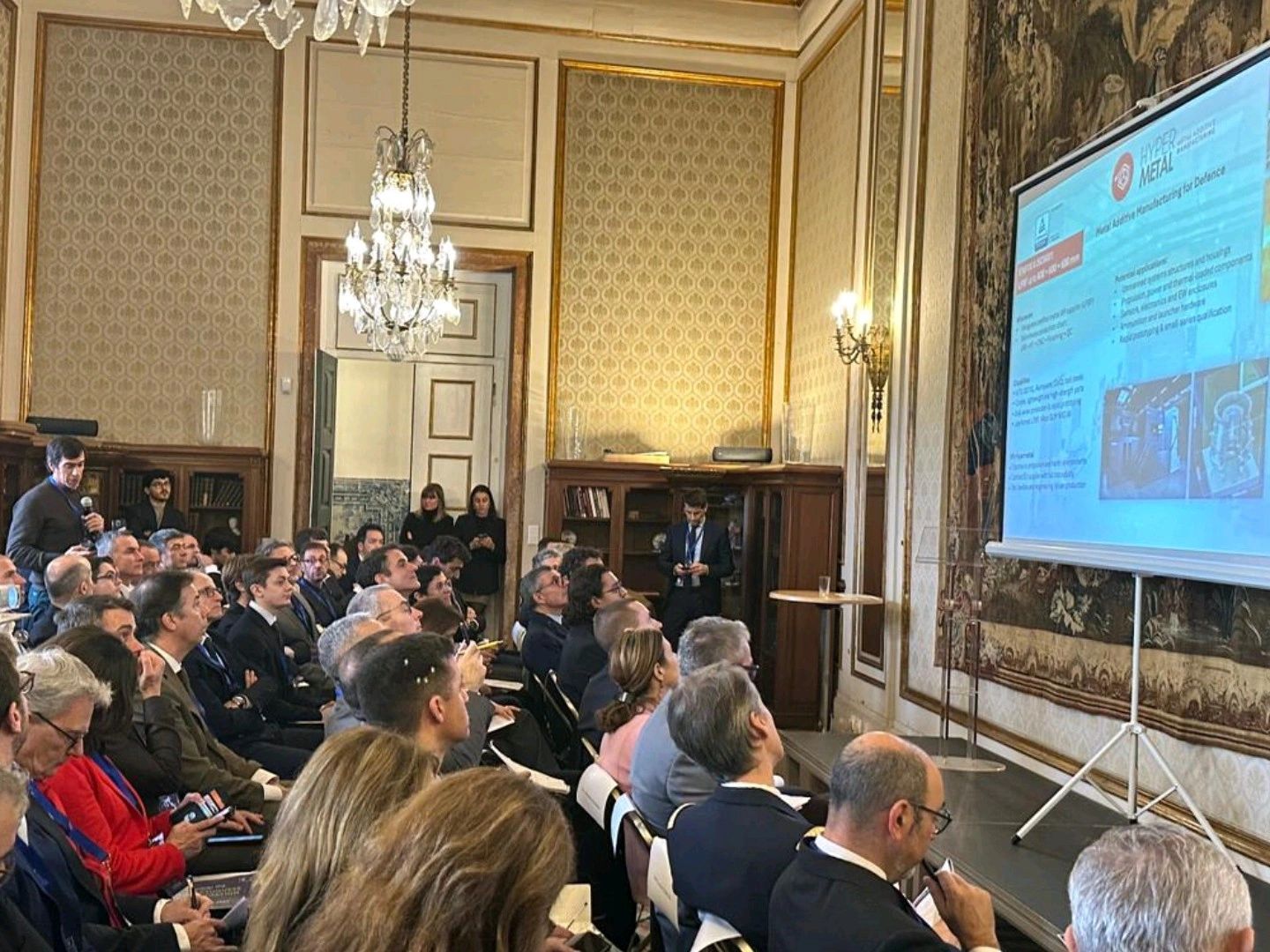
In this context, Hypermetal also highlighted its commitment to large-format LPBF, with capacity up to 600 × 600 × 600 mm, reinforcing its ambition to address more demanding industrial requirements in terms of size, performance and qualification.
This commitment is supported by the co-funded project “Innovation and Digital Transition Programme – Metal additive manufacturing in the aerospace sector”, under COMPETE2030-FEDER-02266600, with a total eligible cost of €4,584,131.54 and €1,833,652.62 in European Union financial support, corresponding to 40% co-funding. As stated on Hypermetal’s project page, this investment is intended to increase the size of the parts the company can manufacture and strengthen its positioning in large-scale metal additive manufacturing.
This investment will significantly strengthen Hypermetal’s technological offering for the aerospace sector and for other highly demanding sectors, including defence and space. In these fields, the ability to manufacture critical, complex and qualified metal components is becoming increasingly strategic.
Hypermetal’s presence at this event further reinforces its commitment to advanced industrial programmes and international cooperation opportunities, in a context where metal additive manufacturing is increasingly recognised as a relevant industrial technology for the autonomy, resilience and competitiveness of Europe’s technological and industrial base.